Introduction
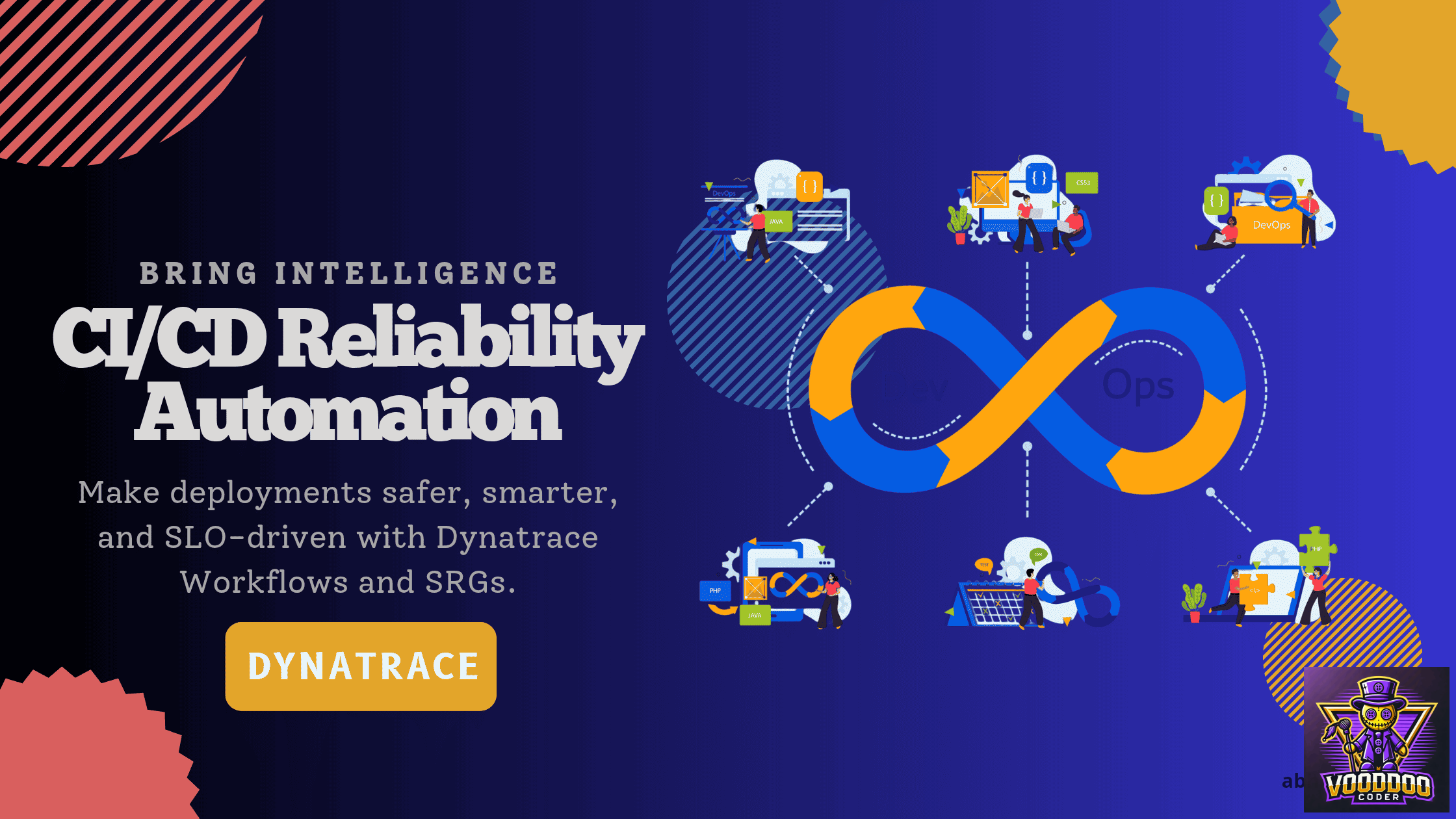
CI/CD pipelines help us ship faster. Observability helps us ship safer.
But when you combine CI/CD + Dynatrace Workflows + Site Reliability Guardian (SRG), you get something even better:
A self-governing, SLO-driven delivery system that automatically validates, approves, or blocks releases based on real-time reliability data.
This is the future of DevOps and SRE — and it makes developers’ lives dramatically easier.
---
1. What Is Site Reliability Guardian (SRG)?
SRG is Dynatrace’s reliability governance layer.
It acts as an intelligent quality gate that evaluates:
- SLOs
- Error budgets
- Performance baselines
- Deployment metadata
- Davis AI anomaly signals
- Business impact
SRG decides whether a release is:
- Approved
- Conditionally approved
- Blocked
And it plugs directly into both CI/CD pipelines and Dynatrace Workflows.
Think of SRG as the “reliability brain” that ensures every deployment is safe before it reaches production.
---
2. How SRG Fits Into CI/CD + Dynatrace Workflows
A. CI/CD Triggers SRG Evaluations
When your pipeline deploys a new version, it sends a deployment event to Dynatrace.
SRG immediately evaluates the release using:
- SLO health
- Error budget burn rate
- Latency and throughput changes
- Regression detection
- Davis AI anomaly insights
This evaluation becomes a gate in your pipeline.
If SRG says “healthy,” the pipeline continues.
If SRG says “risky,” the pipeline halts or triggers remediation.
---
B. SRG Drives Dynatrace Workflows
SRG doesn’t just evaluate — it orchestrates.
Based on evaluation results, SRG can trigger Workflows to:
- Roll back the deployment
- Scale services
- Restart pods
- Notify teams
- Create Jira/ServiceNow tickets
- Trigger canary or blue/green adjustments
- Run synthetic tests
- Validate downstream dependencies
SRG = decision-making
Workflows = action-taking
Together, they create a closed-loop automation system.
---
C. SRG Makes CI/CD Pipelines Smarter
Your pipeline becomes reliability-aware:
- “Deploy only if error budget > 30%”
- “Block release if p95 latency increased by 20%”
- “Pause rollout if Davis AI detects anomalies”
- “Auto-approve hotfixes if SLOs are stable”
This is progressive delivery with intelligence, not just automation.
---
3. What You Can Achieve with CI/CD + Workflows + SRG
1. SLO-Driven Release Governance
SRG ensures every release meets reliability standards before it moves forward.
2. Automated Deployment Validation
SRG evaluates → Workflows act → CI/CD responds.
3. Intelligent Rollbacks
If SRG detects a regression, Workflows can:
- Trigger Helm rollback
- Revert Argo CD sync
- Roll back Kubernetes deployment
- Disable feature flags
All without human intervention.
4. Auto-Remediation
SRG identifies the issue, Workflows fix it:
- Restart services
- Scale up pods
- Clear caches
- Trigger failover
- Run diagnostic scripts
MTTR drops dramatically.
5. Change Impact Analysis
SRG correlates:
- Code changes
- Deployments
- SLO violations
- Incidents
- Business KPIs
Developers instantly see which change caused the issue.
6. End-to-End Traceability
Every deployment is tied to:
- SLOs
- Performance metrics
- Logs
- Traces
- Business impact
This is gold for debugging and audits.
---
4. Why Developers Love SRG + Workflows + CI/CD
A. No More Manual Checks
SRG handles reliability validation automatically.
B. Faster, Actionable Feedback
Developers get immediate clarity:
- “Your deployment passed all SLO checks”
- “Latency regression detected — rollback triggered”
C. Fewer Production Incidents
SRG blocks bad releases before they reach customers.
D. Less Toil
Workflows automate everything from validation to remediation.
E. Higher Confidence
Every release is backed by real-time reliability intelligence.
---
5. Example: A Fully Automated, SRG-Driven Deployment Flow
- CI/CD deploys new version
- Pipeline sends deployment event to Dynatrace
- SRG evaluates SLOs, error budgets, anomalies
- If healthy → pipeline continues
- If risky → SRG triggers Workflow
- Workflow rolls back, notifies team, opens ticket
- CI/CD marks deployment as failed
- Developers get instant insights on what went wrong
This is autonomous reliability governance.
Conclusion
Integrating CI/CD pipelines with Dynatrace Workflows was already powerful.
But adding Site Reliability Guardian turns the entire system into a self-governing, intelligent, SLO-driven delivery engine.
It ensures:
- Safer releases
- Faster feedback
- Fewer incidents
- Automated remediation
- Higher developer productivity
For modern cloud-native teams, this trio — CI/CD + Workflows + SRG — isn’t just a nice-to-have.
It’s the foundation of reliable, scalable, autonomous software delivery.